
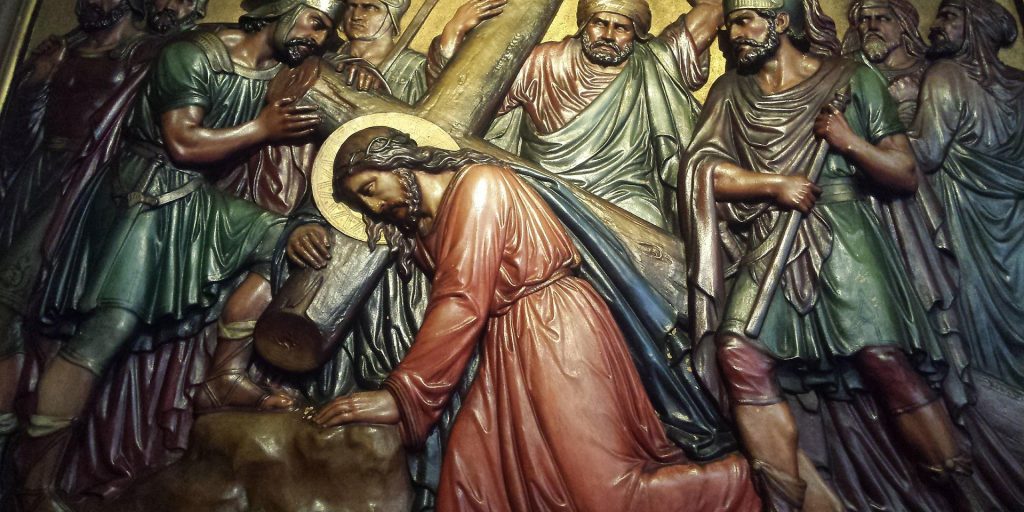
Keeping Station at the Cross
I will remember the deeds of the Lord;
yes, I will remember your wonders of old.
I will ponder all your work,
and meditate on your mighty deeds.
Your way, O God, is holy.
What god is great like our God?
-Psalm 77:11-13
The Mighty Deeds of God
The works of God are worth retelling. In fact, they demand it. That is the Jewish and Christian instinct found throughout Holy Scripture. Taking the Exodus as a key instance here, in the Passover and the Feast of Unleavened Bread, the people of God were commanded to keep a yearly observance of their rescue from Egypt. Think of the sharing in the Passover lamb and the application of its blood to the Israelite households. Here, we are told,
When you come to the land that the Lord will give you, as he has promised, you shall keep this service. And when your children say to you, ‘What do you mean by this service?’ you shall say, ‘It is the sacrifice of the Lord’s Passover, for he passed over the houses of the people of Israel in Egypt, when he struck the Egyptians but spared our houses.’” And the people bowed their heads and worshiped.
Then the people of Israel went and did so; as the Lord had commanded Moses and Aaron, so they did (Exodus 12:25-28).
Do you see there how the successive generations are “caught up” in and participate in the original event? And, of course, as great and mighty as that original Exodus was, it is merely a type and shadow of good things to come. Christ, the antitype, is far greater. In fact, the accomplishment of his Cross & Resurrection was described as an exodos (see Luke 9:31). How much more then are we to laud, retell, rehearse, and acclaim the accomplishment of the Cross?
Of course, the primary way we do this as Christians is by gathering around the Word of God and sharing in Holy Communion together. But, in the Great Tradition of the Church, this impulse to retell and proclaim the works of God has come out in other ways, too. One such way is the devotion known as the Stations of the Cross. Meditating on the Cross of Christ can often feel like trying to hold the ocean in your hands, but here, the nectar of mercy drops slowly in a way that we can perhaps better digest.
The Origin & Theology of the Stations
Starting the journey of the Stations in Gethsemane reminds us that no one foisted the Cross upon Jesus. It was his own, given and received in love and in union with the Father’s purpose. Share on XThe Stations of the Cross is a treasure of the Western Church. As noted above, it arises out of the Christian reflection on and commitment to the great acts of God in Jesus Christ. Indeed, that adoration itself arises out of God’s own commitment to history in a way not found in any other religion. Many Christians rehearse weekly (if not daily) the reality that Jesus Christ was crucified “under Pontius Pilate.” That is to say, Jesus died and rose, not in a land “far, far, away,” but in a place you can go and visit still today. God accomplished the salvation of the world on the hardwood of a Roman cross, within the scope of history itself. For Christians, history is now a story of redemption rather than a tragedy.
This Christian reflex can be seen early on, above all, in the keeping of the Eucharist (meaning, “to give thanks,” and drawn from the Institution Narratives). “For as often as you eat this bread and drink the cup, you proclaim the Lord’s death until he comes” (1 Cor. 11:26). But this soon appears in other ways, too. Justin Martyr, writing in the mid-second century A.D., attests that “a certain cave” was known and kept by Christians as the place of Jesus’ birth.[1]
After the legalization of Christianity under Constantine, this reflex begins to blossom. The pilgrim Egeria, writing around 380 A.D., attests to the worship of the Jerusalem church under Bishop Cyril of Jerusalem. Here, we see the true origin of the Stations service as the “stational liturgies” are born. Listen to Egeria’s description of the Jerusalem church’s observance of the events at Gethsemane:
And at the first cockcrow they come down … and arrive at the place where the Lord prayed, as it is written in the Gospel: and He was withdrawn (from them) about a stone’s cast, and prayed, and the rest. There is in that place a graceful church. The bishop and all the people enter, a prayer suitable to the place and to the day is said, with one suitable hymn, and the passage from the Gospel is read where He said to His disciples: Watch, that ye enter not into temptation; the whole passage is read through and prayer is made.
And then all, even to the smallest child, go down with the Bishop, on foot, with hymns to Gethsemane; where, on account of the great number of people in the crowd, who are wearied owing to the vigils and weak through the daily fasts, and because they have so great a hill to descend, they come very slowly with hymns to Gethsemane. And over two hundred church candles are made ready to give light to all the people.
… then the passage of the Gospel is read where the Lord was taken. And when this passage has been read there is so great a moaning and groaning of all the people, together with weeping, that their lamentation may be heard perhaps as far as the city.[2]
Continuing on Good Friday morning, the people would follow the bishop, trekking through the city to the foot of the cross itself. As pilgrims like Egeria returned to their homelands, they took this devotion with them, birthing what we now know as the Stations of the Cross.
The Practice of the Stations
The Stations service is a flexible devotion. It can be used in groups or alone, over a single day or over many. Each “step” in the Cross normally includes a reading from Scripture, meditation, and prayer. As I argue in my book At the Cross: Reflections on the Stations of the Cross, the particular order of what is known as the “Biblical Stations of the Cross” is, I think, richer fare (and, based on Egeria’s witness, could be said to be the older practice!). Here, we have fourteen stations or “steps” in the Cross of Christ:
- Jesus prays in the Garden of Gethsemane
- Jesus is betrayed by Judas and arrested
- The Sanhedrin judges Jesus
- Jesus is denied by Peter three times
- Jesus is judged by Pilate
- Jesus is scourged and crowned with thorns
- Jesus takes up his cross
- Simon of Cyrene helps Jesus to carry his cross
- Jesus meets the women of Jerusalem
- Jesus is crucified
- Jesus promises his kingdom to the repentant thief
- Jesus entrusts Mary and John to each other
- Jesus dies on the cross
- Jesus is laid in the tomb
Again, Gethsemane itself is particularly significant. Starting the journey of the Stations in Gethsemane reminds us that no one foisted the Cross upon Jesus. It was his own, given and received in love and in union with the Father’s purpose. The cross begins in the heart of God. As I have written elsewhere (and written contrary to other modern renderings on the meaning of the Cross), beginning in Gethsemane also emphasizes the very heart of the Cross: Christ in the stead of sinners.[3]
The Purpose of the Stations
Over the course of this Lent, I was stuck by a passage in one of St. Augustine’s Eastertide sermons. The context of the sermon is the Parable of the Barren Fig Tree in Luke 13:6-9. Here, Augustine fashions the time of Lent as an ugly time. But, he says, it’s a time for focusing on ugly truths that something beautiful may come of it later on – like a farmer spreading his field with “farmyard muck.” It is a place of fertilization for the joy that is to come later. That is a perfect description of the role the Stations of the Cross may play in our lives, both in Lent, during Holy Week, and as a year-round devotion. He writes,
“The scourging, the chains, the abuse, the spittle, the crown of thorns, the wine mixed with gall, the vinegar in a sponge, the jeers, the shame and contempt, finally the cross itself, the sacred limbs hanging on the tree, what does it all signify for us but the time we are living now, a time of sorrow, a time of mortality, a time of temptation? So it’s a foul, an ugly time, but let it be the ugliness of dung in the field, not in the house. Let the sorrow be for sins, not for greedy desires cheated and disappointed. It’s a foul, ugly time, but if used well’? a fertile time. What could be more foul than a field spread with farmyard muck? The field was beautiful before it received its cartload of muck from the dunghill. The field was first reduced to ugliness, in order to attain to fruitfulness. So the ugliness of this time is a sign, but let this ugliness be for us a time of fertility.[4]
The joy of the Resurrection will far outlast this “ugly time,” but there is only one way to get there: through the Cross of Christ. Let us draw near to our crucified Lord with great devotion!
Endnotes:
[1] Justin Martyr, Dialogue with Trypho 78.
[2] “Holy Week in Jerusalem,” Renovaré, accessed April 14, 2025, https://renovare.org/articles/holy-week-in-jerusalem.
[3] In the book, I liken this to the way the horizontal and vertical beams of the cross meet together in the middle. Although they also extend outward, going on “forever” in meaning, they do have a middle: Christ in our place is that middle. The cross means more than just that, but it cannot mean less than that. And, all its other meanings are possible because of this first one: Christ bore the wrath of God for sin in the place of sinners.
[4] Sermon 254. The Works of St. Augustine, Vol. 7, John E. Rotelle, ed. (New City Press, 1993), 154, Archive.org.
Image by Harry Fabel from Pixabay

Justin Clemente
Justin Clemente serves as the Associate Pastor for Holy Cross Cathedral, the cathedral church of the Anglican Diocese of the South (ADOTS) in the Anglican Church in North America. He’s also a core writer over at Anglican Compass and author of At the Cross: Reflections on the Stations of the Cross, recently published by the same. He has a supportive and strong homemaking wife of twenty-one years and six beautiful children. They’re the best thing he’s ever done.
Advertisment
