
Becoming Anglican: An Unexpected Journey
We are becoming Anglican.
I never thought I would write those words. Up until recently, just over a year or so, the Anglican tradition was never seriously on my mind aside from brief thoughts of “those people over there that I don’t quite understand.” Then the Lord saw fit in his good providence that this life-long Baptist, who fell in love with Reformed theology in college, would go to a Presbyterian seminary, stay convictionally Baptist, only to get halfway through his PhD at an SBC seminary and become Anglican. So, how did I get here?
To answer that question, I will not provide a thoroughgoing defense of Anglican theology over against Baptist theology (which one can find elsewhere). Rather, this is simply the thoughts of a man whose world took an unexpected, but I believe, much needed theological turn.
My Theological Road
For starters, I did not want to be re-routed. I grew up in a non-denominational church, though my mother was raised in the SBC. Theology as a discipline was not overtly looked down on, but it wasn’t exactly an emphasis either. In college, I attended an SBC church and was very involved in the college ministry leading a Bible study. It was at this time when I was exposed to Reformed theology and fell in love with the word of God in a way I had never known before. At the time, my mother was fighting a losing battle with cancer and I needed the sovereignty of God in my life.The Lord saw fit in his good providence for this life-long Baptist to get halfway through his PhD at an SBC seminary and become Anglican. Share on X
That love of and commitment to Reformed theology has not wavered. Due to my training in philosophy and logic, I am a man who loves consistency. Insofar as I am able to work out the logic of doctrines, my mind will not remain at rest if I am not living things out in a consistent way. This is how I came to Westminster Theological Seminary in Philly. There are two things I wanted out of seminary: Reformed theology and academic rigor. I wanted school to be hard and to be rooted in Reformed theology because that is what Scripture teaches. I also wanted to know about infant baptism. I didn’t necessarily want to believe it, but I also knew that I didn’t know enough about it to dismiss it either. I went into Westminster a Baptist and wanted to stay that way. But I also knew that I was not doing my due diligence if I couldn’t come out on the other side with my degree and say “this is the exact case for infant baptism and this is why they believe it’s biblical.” Even if I still disagreed with it I wanted to be absolutely sure I was disagreeing with the actual doctrine and not a straw-man. As I left for my PhD, I can honestly say I achieved that goal and was happy. I also came out of Westminster with a newfound love of Covenant theology. After graduation, my heart’s desire was to be ever more consistent in my theology and practice with the unified plan of God that spanned the Old and New Testaments. However, at that time, I was convinced that I could hold to it consistently without believing in infant baptism.
My desire, after Westminster, was to get a PhD in Systematic Theology so that I could teach theology and eventually write a multi-volume Baptist systematic theology which properly combined the truths of covenant theology with a properly covenantal credobaptism. Since I wanted to remain in the Baptist world, I went to Midwestern Baptist Theological Seminary because I believed at the time it offered the best systematic theology program in the Baptist world. For the first two years of my coursework, my convictions did not change. I read the best works of covenant theology by Baptists (Coxe, Reneihan, Denault, and others). However, I believed (and still do) that the one covenant of grace with two administrations is the best model for covenant theology, and my desire was to address the way that model could be upheld with credobaptism. Perhaps some at this point will say “see there is your problem right there! I knew we would find the culprit. You were never truly Baptist.” Yet, No True Scotsman-ing aside, that was still my conviction after reading the Baptist divines.
Sloganeering and Re-Routing
So what changed? I can boil it down to three areas: consistency in baptism, raising children, and living in the church. Here I must say upfront that I still love all of my Baptist friends. Yet, I feel the need to say this now and with candor because my dear Baptists, whether they want to admit it or not, have a broad (though not universal) tendency to take the changing convictions of one of their own very personally. Men simply aren’t allowed to change their minds without others nitpicking all of their reasoning. Nor can one do so without the snide, often triumphalistic sloganeering of “stay Baptist” pouring forth from many fingers and lips.
I must admit that I was not too keen to share my changing convictions after watching the aftermath of my friend, mentor, and PhD advisor, Matthew Barrett announcing his move to the Anglican tradition as well. Anglicans were overjoyed, Presbyterians were rather happy or else unfazed, whereas many Baptists treated the change in a way that I must say, seems only slightly less intense than the Capulets’ feelings towards the Montagues. It is not easy to watch someone you respect be treated so harshly when you are trying to wrestle with the same thing, knowing now what it might cost you. But those who know me have never accused me of being a people pleaser and the truth is worth telling, so here I am.
The Road to Infant Baptism
The first time the road started to unravel was actually in an attempt to convince a personal friend of mine to not agree with infant baptism. He was wrestling with it all and I agreed to talk it through with him. I actually agreed to re-read everything I read from Westminster on the subject so that I could point out to him exactly where I took issue with it. However, as I did so, I noticed something, specifically in John Calvin. Calvin addresses pretty much every common objection leveled against infant baptism in his Institutes and as I read his responses, I remember feeling like my objections were not landing as hard as they used to. The objections of Baptists today are essentially no different than in the 16th century, and he had a good response to them all. But how is that possible if I had read them already and not been fazed the first time? I did not want to change my mind. I felt that I had to because that is what was demanded of me if I am to be an honest theologian. Share on X
You see, in an argument, to refute the validity of one’s argument you have to first say “assuming this is true, does it necessarily follow?” Whether the premises and conclusions are true comes after the fact. This time around I had to do something that I had not seriously done before, which is to assume the actual covenantal hermeneutic of the Reformers regarding the subject of infant baptism to determine whether the conclusion of infant baptism necessarily follows from that hermeneutic. Once I did that while reading Calvin, things unraveled very quickly. I distinctly remember reading the Institutes on a Saturday morning, pen in hand, and after reading one of his refutations, putting my pen down and going “Dang it. I’m changing my mind, aren’t I?” And this is something I want to reiterate: I did not want to change my mind. I felt that I had to because that is what was demanded of me as an honest theologian.
One thing that I noticed was that Baptists by and large (me being one of them) simply do not understand the hermeneutics behind infant baptism. We are only willing to consider the issue from within our Baptist hermeneutic. So, we take our Baptist hermeneutic and analyze from a distance our brothers who baptize their infants. We simply aren’t willing to ask the question, “What does the Old Testament have to say about the subject?” That question, whether we want to admit it or not, is routinely dismissed as either irrelevant or invalid. But once one seriously asks that question and lets the Old Testament speak fully into the subject, the arguments against infant baptism simply have no force. If there is one people of God, and if God deals with them in a consistent manner, then if the Gentiles are now included in the covenant, which we call the New Covenant, that does not invalidate the consistent inclusion of the infants of believers in the conventional life of the people of God. I finally saw that the reason Presbyterians, Anglicans, and others are so fixed on Acts 2:39 is because the phrase “the promise is for you and for your children, and for all who are far off” is a covenant promise drawn straight from the Old Testament.
You see, as a Baptist, we read those words “for you and for your children, and for all who are far off” as three distinct and separate categories of people for whom the command “repent and be baptized” is applied to in the exact same way. Jewish adults are commanded to repent and be baptized upon their new profession, so the other groups must be as well. And while that is true of newly professing adult Gentiles, for a Jew hearing those words, they would not hear three distinct groups, but two: “For you and your children, and all who are far off.” Why? Because the prophecy from Joel 2:28-29, which Peter quotes to justify their need to repent and be baptized includes the children as part of the full recipients of that prophecy: Joel 2:15-16 “Blow the trumpet in Zion; consecrate a fast; call a solemn assembly; gather the people. Consecrate the congregation; assemble the elders, gather the children, even nursing infants.” And that is the consistent pattern of the Old Testament. Children, even infants, are always included in the covenantal promises of God, and of course, the sign that seals them in that people, which is circumcision. It is even the same in Jeremiah 31, which I so often loved to quote in refutation. You see, that promise continues in Jeremiah 32:38-39 and says “And they shall be my people, and I will be their God. I will give them one heart and one way, that they may fear me forever, for their own good and the good of their children after them.” If those prophecies speak to New Covenant realities (which they do) and if the children of Jews are still included in those promises (which they are) and if there is one people of God (which there is), then there is no reason the inclusion of infants in the covenant sign would cease once the New Covenant began in earnest. Nor would there be any reason to make that explicit connection with baptism because that connection was already there. The pattern did not change; it simply expanded to include Gentiles and their children too. I remember reading Reformed Covenant Theology still wrestling with this issue and when it started explaining these connections I actually wrote in the margins of my book “What is the response to this?” The evidence was simply too overwhelming. But it is only so if you allow the Old Testament to speak into the New the way it was designed to do so. It is a different hermeneutic which allows the covenantal language of that phrase “for you and your children” to speak into the life of the church as intended by God the Holy Spirit. That is what I was missing and once I could see it, I could not unsee it. The evidence for infant baptism was simply too overwhelming. Share on X
What always troubled me about the implications of a Baptist covenant theology is that it always felt like the emphasis on the newness of the New Covenant meant the New Covenant was “separate from” the Old Covenant. For some, of course, that is a feature, not a bug. But God carves paths through his garden; he does not create separate plots. He is consistent with His covenant people in His one unchanging plan of redemption for the Church. That plan has always included the children of the people of God in His promises and that includes the covenant sign of circumcision first given to Abraham and his children, and now to us and our children in baptism. There is of course more I could say, and I know that the conversation is more nuanced, but that is a snapshot of my thought process.
A Gift of God
This next part connects with my stance on baptism and that is the birth of our son, Theodore. An accusation is often leveled by Baptists against people that the only or primary reason they believe in infant baptism is because they just want their children to be saved. In other words, the convictions of those who change their minds about infant baptism are dismissed as the result of being emotionally weak. It is a sign of a feeble heart rather than a genuine change of mind based on biblical convictions. I was very aware of this concern in my own mind. I did not want to change my mind simply because I wanted Teddy to be saved, because I did not believe the water was salvific in and of itself. I still don’t believe that. However, the simple reality is that having kids does change the way you see reality and that is ok. It is not a sign of weakness to genuinely reflect on how you are supposed to raise your children according to the word of God. The desire to see your children saved is a good thing and one’s stance on infant baptism, for or against, is not in and of itself a sign of how strong your affections may be for your children. Both credobaptists and infant baptists love their children deeply. One’s position on either side is not a sign of a disordered love for one’s children. Having kids does change the way you see reality and that is ok. It is not a sign of weakness to genuinely reflect on how you are supposed to raise your children according to the word of God. Share on X
But my wife and I found ourselves seriously asking “are we supposed to raise Teddy as a Christian or as an unbeliever we want to be Christian?” Certainly, there is an evangelistic spirit to raising children, but how does Scripture speak about the children of believers? This is perhaps where you would expect me to cite 1 Corinthians 7:14, but I will leave that aside here. For me, I found the answer in an unsuspecting place: Ephesians 6:1 “Children, obey your parents in the Lord, for this is right.” This is of course, not talking about infant baptism directly, so do not hear me saying that it makes a definitive case. Baptists certainly do teach their children to obey them in the Lord. But what struck me about that phrase is that “in the Lord” is again, covenant language. The children seem to be assumed as part of the Christian body. This is only furthered by Paul’s citation of the fifth commandment which comes “with a promise.” What could this be other than Paul assuming that children are part of the covenant body because of their relationship to their parents? I can say with full conviction that this decision about baptism was not emotionally driven, but a theological decision which helped direct the natural affections we have for our son. For that, I am not ashamed, but assured.
One, Holy, Catholic, and Apostolic Church
The last leg of this re-routed road has been the toughest but one of the most important. My wife and I realized we could no longer stay Baptist with a clear conscience. But where would we go? The obvious answer seemed to be the Presbyterian church because that is the only other tradition we knew and knew well. I love the Presbyterian church. I would not be the man I am without it because the theology I learned from Westminster and their divines didn’t just influence me, they formed me. But I am also a man who loves history. I did not want to jump into the Presbyterian world simply because it was the only other place I knew to go. Remember, I like being consistent. I wanted to be consistent with the history of the church.
I always considered myself a Christian first. One thing that always bothered me about living in the Baptist world is how obsessed they are with their identity of being Baptist. Share on XI was never “proud” of being a Baptist. I do not mean that I didn’t like being one; I definitely did. But I always considered myself a Christian first, and then one who was Baptist. Being around other denominations so frequently exposed me to the wider world of Christian theology. On the one hand, I have no issues with being proud of one’s tradition. Baptists have much to be proud of and many of my good friends are proud to be Baptist in the godliest way possible. On the other hand, one thing that always bothered me about living in the Baptist world is how obsessed they are with their identity of being Baptist. I use that word “obsessed” deliberately. What I have seen is a requirement to fit everything into a Baptist mold before it can be adopted, along with a default sense of skepticism towards anything that does not have the Baptist moniker attached to it. One simply can’t do retrieval; it must be Baptist retrieval. Affirming the Creeds, such as the Nicene, is okay if a church feels comfortable doing so, but there is no sense of obligation to do so. In fact, doing so might be seen as “too Catholic” and “not very Baptist.” The Reformation isn’t complete unless one looks as different as possible from the Roman Catholic church. But is everything we dislike merely “a part and pillar of popery”?
When the SBC’s executive committee rejected adopting the Nicene Creed in the BFM, it felt like the death blow. Share on XAs we continued to grow as a family, I felt a deeper longing to be part of the church catholic (universal) and not merely a corrector of it. Certainly the errors of the past must be dealt with and removed without hesitation, but the Baptist distinctives of independence and congregationalism push this desire too far. When the SBC’s executive committee rejected adopting the Nicene Creed in the BFM, it felt like the death blow. And the answer that particular churches can still choose to adopt the Nicene Creed misses the point entirely. In what sense can we as a denomination seriously claim not just biblical faithfulness, but the most pure form (or only form) of biblical faithfulness, if we are unwilling to insist as a whole denomination that all churches that claim to be biblical, confess the historic creed whose adherence was the standard evidence of genuine faith? The creeds, as a ministerial authority, were written to serve as a test of genuine fidelity to the magisterial authority of Scripture. And in that sense, fidelity to the creeds seems not only good but necessary. There is a level of historical and theological significance to the creeds that makes our confession of them obligatory. We defer to them not because they are equal to Scripture, but because they are greater than us. Ministerial authority does not mean it’s an optional authority. I know saying that will make some uncomfortable, but I mean it. If one can take or leave the Ecumenical Creeds on an institutional level, then they are not an authority in any meaningful sense. The reality is that congregationalism is intentionally not institutional. There is no way to bind or obligate individuals or individual churches to creeds that they do not want to uphold. That certainly has its benefits, but it also has its serious drawbacks. Again, for Baptists, that is a feature, not a bug. But for me (and most other traditions), that is a major crack in the road I was on.
If one can take or leave the Ecumenical Creeds on an institutional level, then they are not an authority in any meaningful sense. There's no way to bind churches to creeds that they do not want to uphold. Share on XWe were fortunate to be part of several very godly and wonderful congregations. Our changes in conviction are not the result of any negative experiences within those specific churches. In fact, for a long time, I struggled with a profound sense of sadness and loss at what we were giving up. But my concerns kept growing; they were not being alleviated. Despite passionate arguments to the contrary, elder-led congregationalism does not strike me as the obvious, much less only, true biblical model of ecclesiology, neither from exegesis nor from history. It really only starts in the 17th century. Now that alone doesn’t completely discredit it. Obviously, the model can be very successful and produce much godly fruit. That is not in dispute here. We were very fortunate that our churches were very healthy and full of godly elders, but should a serious issue arise that could not be solved within the body, what authority above the local congregation could we appeal to in order to alleviate the issue? There was none. And if it was the true biblical model, why does it virtually disappear aside from very small pockets until the time after the Reformation? And if one claims that the ecclesiology was so corrupted from the early days of the church that it all but disappeared as early as the 3rd century, if not sooner, that seems more like a restorationist claim than a reformation movement to my mind. It eventually became clear that we could not in good faith remain in the Baptist world if what makes a Baptist a Baptist was no longer true.
If one takes seriously the historical development of the church in time through a successive line of bishops (as Irenaeus calls it as early as the 2nd century), it goes towards episcopacy very quickly and stays that way. Share on XAll of that said, one of the reasons we did not go the Presbyterian route is that many of the same objections I had towards congregationalism about novelty and pride apply to the Presbyterian world. Presbyterians love to be Presbyterian, and for good reasons. However, Richard Hooker in England was arguing in much the same way against the Presbyterians in the 16th century as I am arguing against the congregationalists now. As much as I love the Presbyterian church, it too, while claiming to be the de jure model of church polity, does not exist until the 16th century. That is a hard historical pill for me to swallow. That is not to say it is necessarily unbiblical. In a move that satisfies nobody, my conviction is that there is freedom in the body of Christ to have those differences, but if one takes seriously the historical development of the church in time through a successive line of bishops (as Irenaeus calls it as early as the 2nd century), it goes towards episcopacy very quickly and stays that way. I am not denying that eventually, certain abuses emerged, but the episcopal ecclesiology itself endured. Even during the Reformation in England, when so much had to be reformed, episcopacy was not removed but retained. I recognize that the situation was politically complicated, but in the end, the episcopacy structure not only found room for but became a natural home for the pillars of Reformation theology and does so still to this day. Though I am a novice and no expert on these matters, I can find comfort in the historical consistency of that model–a catholicity–which I find lacking in the others.
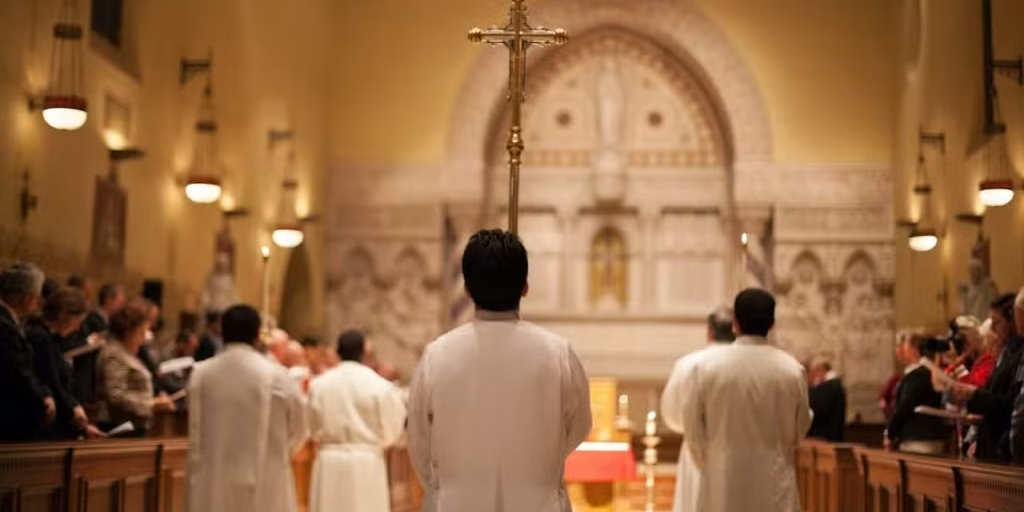
Finally, something that we found in the Anglican liturgy that I did not expect but have now come to hold dear are the realities of beauty and participation. The whole liturgy is intentionally designed for the whole congregation to be involved. The singing, call and response, reading from Scripture, prayers, reciting the Nicene Creed, and even the Eucharist are things in which the laity participates; they are not mere spectators. That is not to say there is nothing of participation in congregationalism or Presbyterianism, but there is a real sense in which the members of the church watch church happen rather than live church out. The liturgy of the Anglican church requires your full attention from start to finish and draws you into the service, up to God. Your heart, as the sursum corda says, is lifted up to the Lord.
The purpose of the incense is to lift your heart to the sweet aroma of Christ through our spiritual sacrifice of thanksgiving and praise, which we give, according to Paul, in our bodies. Share on XAnd with that comes the beauty. Everything, from the reading of the lessons in every part of the Bible, to the sermon, through to the Eucharist, and yes, even the vestments, is objectively beautiful because it is trying to reflect the beauty of God. In the Anglican church, beauty is intentional because it is consistent with the beauty of our Triune God. It is a sad state where some Christians, in an ad-hominem fashion, dismiss the sensory elements of the Anglican liturgy as just being attracted to “smells and bells.” The reality is that we are embodied souls. We need renewal not just in our minds but in our bodies. We were designed to worship the living God through our bodies, which involves all five senses. It is certainly different to smell incense during a service (should the parish use it), but the purpose of the incense is to lift your heart to the sweet aroma of Christ through our spiritual sacrifice of thanksgiving and praise, which we give, according to Paul, in our bodies. I do not simply want to worship Christ in my mind, though of course I do. I want to worship Christ with my whole being, body and soul. That is something, especially through the weekly Eucharist, that the Anglican church provides in spades. You don’t simply take the elements; you receive them. You don’t merely remember Christ, though of course you do; you participate in Christ’s body as you eat his flesh and drink his blood through faith (1 Cor. 10:16-17).
The Road Goes Ever On
This journey has not been without a cost. Oftentimes, it has felt incredibly lonely and confusing. I made it all the way through PhD seminars into dissertation writing only to come to the conviction that the road I thought I was supposed to travel on was not my path. It has felt like I am giving up everything I’ve ever known to lead my family down an unknown road I have yet to travel. But God is gracious and near, hearing my prayers. What I wanted for my family more than anything was a church tradition where the Christian life was meant to be lived daily along the same road as the saints who came before me. I wanted to be part of a genuine connection to church history, without a constant need to correct it. I wanted my family to run the race down the well-worn roads of the Church: one, holy, catholic, and apostolic.
I do not pretend that the Anglican church is the perfect solution to all the Bride’s problems. It is not. There is much work to be done in the Anglican world, as we have seen in recent days. I am not joining because I think it is a place free from the threats of the enemy. Satan’s schemes are underway to undermine this holy communion. But I do know this: it is a place where I can raise my family knowing that the word is faithfully preached and the sacraments are rightly administered. I know catechesis, full commitment to scripture, love of catholicity and the communion of the saints, and affection for God will be embodied each week. I believe that at its best, the Anglican church is capable of most faithfully adhering to the faith once for all delivered to the saints. In short, this imperfect church is a place where I can lead my family to worship the Lord in the beauty of holiness.
Glory be to the Father, and to the Son, and to the Holy Spirit. As it was in the beginning, is now, and ever shall be. World without end. Amen.

Connor Shackelford
Connor Shackelford is the executive editor at Credo Magazine. He is also a PhD candidate in Systematic Theology at Columbia Seminary and teaches Bible at Hartfield Academy in Flowood, MS. He is married to his wife Caroline, and they have one son, Teddy.
Advertisment
