
A Letter to Every Student
We are living in a day when universities are terminating their liberal arts education. The reasoning of these universities is quite modern: these degrees are not practical. No obvious job is waiting after graduation. Nor do these jobs produce a tangible product, let alone one that is profitable. In our modern day when success (and with it, a person’s value) must be quantified, the only question that matters is: why is that degree useful?
The collateral damage to the human person is conspicuous. When college is reduced to a career, the success of which is only measured by its product, virtue—and with it, the formation of the whole person—is no longer relevant. And with the absence of virtue, why live in wonder at that which is good, true, and beautiful and for no other reason that it is good, true, and beautiful?
Each month I host a gathering of students in my home, and I call it Anselm House, named after the first scholastic, Anselm of Canterbury. After coffee and a delicious pastry, we sit down and read a classical text out loud. After listening to a voice from another world, we then participate in a Socratic dialogue. At the end, we sing the doxology.
I’ve asked myself, “Why do these students come?” After all, they have classes, homework, and jobs, not to mention friends much cooler than a middle-aged man obsessed with old books. After several years, I think I’ve found the answer: for two hours nobody is telling them to be practical, nobody is judging them by their performance on social media, nobody is calculating their worth by their networking potential. For a brief evening, they do not have to be Martha but only Mary.
Sit, I say to them, and be still. We give you permission to be lost in thought. Simply contemplate God, not because it is useful but purely for the love of God. Simply because it’s worth it in and of itself. And you know what happens? Like a child who has a butterfly land on its hand, the rest of the world vanishes around them. All they want to do is stand there for hours, lost in wonder at the beauty of the butterfly. Moreover, they are not standing alone. By entering the depths of contemplation in community, virtue begins to penetrate their very being as they enter through the gates of the good life in friendship with others. As Aristotle said in his Nicomachean Ethics, “Perfect friendship is the friendship of men who are good, and alive in virtue.”
The Love of Spectacle
I suspect the launch of a college like New Aberdeen is like discovering a hidden pearl at the bottom of the sea. Why? Because most students today will never encounter anything like it due to their exchange of one love for another. In her book Lost in Thought: The Hidden Treasures of the Intellectual Life, Zena Hitz observes that there are “two kinds of basic restlessness”—the love of learning versus the love of spectacle. “The one sort, exemplified by Augustine’s own journey as he describes it, unceasingly moves past the surfaces of things to what is more real. The second flees unceasingly from the object to object, all on the same level—never culminating in anything further, never achieving anything beyond the thrill of experience. … The love of learning always wants more; the love of spectacle is satisfied at the surface… While the love of learning is exercised by Ambrose alone in his study, engrossed in reading, the love of spectacle seems always to be enmeshed in a crowd.”
It does not take a professor to spot where the love of spectacle triumphs today: it’s the “compulsive use of social media” which Hitz calls a “screwed-up longing for communion.” I think Hitz is right. In fact, I am convinced social media is a candidate for the single-greatest threat to the love of learning today. Perhaps you think I’m being dramatic.
My oldest is a senior in high school and she has been fed a steady diet of the love of learning her whole life. But to participate in an internship she enrolled at the public high school. She came home from her first day of school and she was greeted by a dad curious what her experience was like. “Dad, no one’s alive. I tried to meet people, but they don’t look up. Everyone’s scrolling on their phones in class. And when the teacher tried to get to know them, asking what hobbies they enjoy, the student next to me answered, “does scrolling count?” My daughter came home feeling numb, like nothing’s real. Where the love of learning is absent, that same restlessness that plagued Augustine (Confessions) will plague us until we can rest in something real. Otherwise, no real community follows.
My point is not to shame public schoolers; I don’t doubt there are a variety of experiences to be had. I went to public school myself. My point, rather, is that for the first time in her life, my daughter had to reckon with the love of learning versus the love of spectacle. Which one will she have? Better put, which one will have her? Hitz might as well be describing the fork in the road my daughter knew that day when she says, “In the supremely shallow realm of acting for the sake of acting and a preoccupation with spectacle, growth is impossible. All that lies there is an endless, repeated sequence of increasingly joyless thrills. Our sense of emptiness and lack of satisfaction are signs that we have not in fact attained any human goods or actually connected with other human beings. The dissatisfaction is a sign that we long to attain real goods, and that we long to bond with others in truth, in the depths, and not remain at the surface of things.”
Merely Modern
This fork in the road is not unique to our day. As early as Book 2 of Plato’s Republic, we are faced with a choice: “Tell me, do you think there is a kind of good we welcome, not because we desire what comes from it, but because we welcome it for its own sake—joy, for example, and all the harmless pleasures that have no results beyond the joy of having them.” Plato has fixed our gaze on the core of classical education. If we desire the good not to use it but for its own sake, then what is education but love’s quest to learn? As Plato says, “the love of learning is the same thing as philosophy or the love of wisdom.”
Before you run Plato through the filter of our modern box of education, remember that in the very next breath he speaks of music, poetry, and literature. Take fiction. Stories from imagination do not settle for telling people what’s good. They are so enduring, so penetrating because they show us the good, displaying its embodied form, until its beauty shapes the student’s very soul. Therefore, G.K. Chesterton warns us, “The first use of good literature is that it prevents a man from being merely modern. To be merely modern is to condemn oneself to an ultimate narrowness.”
Have you ever noticed how similar Jesus is to Plato? Jesus puts before his students a story, the story of the good Samaritan, for example. Why? Because one of his students was phony enough to think he could genuinely fulfill the commandment to love God while loving all except those who would cost him his reputation the most. This young student did not want to be good, but he merely wanted to appear good, to use it.
Faculty of New Aberdeen, if you commit your students to the classical way, so that your students love the good—not in some attempt to use it, but for the joy of the good itself—then they will not only love but live the good life? In the minds of Socrates, Plato, and Aristotle, the good life was not the affluence of mindless luxury nor the sloth of perpetual hedonism, as it is for us today, confusing leisure for recreation as we do. Rather, the good life was a quest to become the type of person who radiates virtue, embodying virtues like prudence, temperance, justice, and fortitude.
The Sophist today
Consider fortitude from the perspective of a student born and bred on the love of spectacle. Our day is not all that different from Aristotle’s, a day in which it’s far more spectacular to be a sophist. A sophist looks at his peers, identifies that rhetoric which public opinion will favor, and then postures itself accordingly as if a defender of the truth. In book 11 of his Nicomachean Ethics, Aristotle calls this X, formerly known as Twitter. But seriously, every professor in this room feels the weight, as student after student defines courage not by recalling, say, the martyrdom of Socrates but according to the latest 280 characters. If you think I’m being dramatic, I have watched as students make life-altering choices as significant as changing traditions after one video from a new YouTube personality with half a million views.
Professors, I may just know what’s going through your mind: how can I possibly instill courage in students embedded within a culture of online group think so dominant that it decides the fate of presidential candidates every four years? Philosopher Peter Kreeft, who has taught for decades at Boston College, knows your despair. In his book Back to Virtue, he laments that “sociology has socialized and collectivized morality; consensus determines rightness or wrongness; and democracy becomes our religion: vox populi vox dei (‘the voice of the people is the voice of God’).” But the state of education is more desperate still: What professor could have imagined trying to instill virtues in a student population turning to ChatGPT to validate their psychological state or let alone their pronouns? We are no longer anticipating Aldous Huxley’s Brave New World; we are living in it.
Aristotle (and Jesus) on Courage and Cowards
Yet Aristotle would ask, at what cost? Students, imagine if Aristotle taught your class this semester. To live the good life, he would call on you to be brave. But bravery means your quest for truth, goodness, and beauty is not to be dictated by the consensus of the social media mob. Nor is it decided, ironically enough, by the “virtue signaling” of those who declare themselves courageous. No, the student with fortitude, says Aristotle, “feels and acts according to the merits of the case and in whatever way reason directs.” The student with fortitude does not look to the “democracy of the living” (whoever happens to be alive, says Chesterton) to decide what bravery shall be, as does the sophist, but evaluates whether the end, the telos itself, is good, true, and beautiful. And with no little help from the “democracy of the dead.” As Aristotle says, “it is for a noble end that the brave man endures and acts as courage directs. When the end is noble, the brave man will lay down his reputation, even his life if he must, while the coward will die only to escape such pain altogether. In the words of Aristotle, “to die to escape from poverty or love or anything painful is not the mark of a brave man, but rather of a coward; for it is softness to fly from what is troublesome, and such a man endures death not because it is noble but to fly from evil.”
As it turns out, Aristotle and Christ have much in common. For if the end is noble—like saving a man who has been robbed, beaten, and left to die—then it is not the priest or the Levite who is brave but the Samaritan. While the priest left the man for dead so that he could reach the synagogue where he had a class that day to instruct students in virtue, it was the Samaritan who put virtue into practice. Compassion proved the bridge to courage, mercy the gateway to fortitude. He left that day living the good life.
 |
What does Athens hath to do with Geneva?
At the start, I said New Aberdeen’s recovery of the classical liberal arts is rare today, like finding a glass of water in a desert. But I believe New Aberdeen is more unique still. For it is not only classical but reformed. What does Athens hath to do with Geneva? The Reformed confessions and catechisms are invaluable because the Christian sojourner on his and her way to that happy land of beatitude demands not just any virtues but theological virtues—faith, hope, and love—apart from which we cannot experience the vision of God. For the darkness of our state is not only ignorance (as Plato thought), but death, making its solution not merely knowledge of Logos (as Plato thought) but life through the Logos made flesh. Our depravity requires not only illumination but regeneration.
In this way, the good life and all the happiness it brings takes on additional significance. Relying on Thomas Aquinas before them, the Reformed Scholastics taught their students to pray and ask the Holy Spirit to infuse them with virtues by which they could be consecrated and conformed into the image of Christ. “Make us a good tree,” they prayed, not in order to be justified but because they had been justified. For they knew, as Jesus said, a tree is not a good tree if it bears no fruit.
A classically reformed institution like New Aberdeen is like a glass of water in a desert because the road to the good life is paved by the presence of the Spirit. Aristotle was right to say, happiness is god-given. But the Heidelberg Catechism is right to add that it is the Holy Spirit who is “given to me; to make me by true faith a partaker of Christ and all His benefits” (Lord’s Day 20). Students of New Aberdeen College, with Aristotle, don’t let this secular, disenchanted age tell you the good life is anything but “god-given.” But with Heidelberg never forget that the gift of the good life is the Spirit, given to you by the love of the Father through the grace of his Son.
How then will you educate?
Faculty of New Aberdeen, how then will you educate? There is a Fundamentalism afoot, and it would have you believe that the past is irrelevant to the future. Fundamentalism sees a jungle and shoots dead its exotic animals, all because they heard creatures in the wild are dangerous. Fundamentalism proudly waves the flag of faithfulness but on the very tractor cutting down the forest. New Aberdeen, your entire future is before you, yet the horizon before you, the one in which you will be sending students, is not a jungle but a desert. In The Abolition of Man, C.S. Lewis lays before you your mission: “The task of the modern educator is not to cut down jungles but to irrigate deserts.” The Great Tradition stands behind you. Open its deep wells to your students. Be “liberal,” that is, open those ancient wells to your students so they may drink and be satisfied.
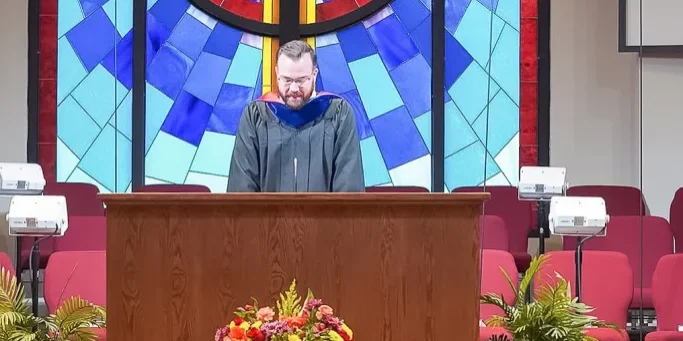
This is the inaugural convocation address Dr. Matthew Barrett delivered at New Aberdeen College near Charlotte, NC.

Matthew Barrett
Advertisment
