
The debate about what it means to be a man or woman is not just fodder for contemporary culture wars. The question of sexual difference has a long philosophical and theological lineage. Sr. Prudence Allen, in her sweeping, multi-volume work The Concept of Woman, argues that the Christian tradition has critiqued, refined, and synthesized competing anthropologies of sexual difference in pursuit of “integral sex complementarity.” This “living idea” of the relationship of man and woman is first revealed in Genesis and holds together the equal dignity and significance difference of the sexes. But the Christian tradition, in the development of the ideal of integral sex complementarity, has had to negotiate flawed anthropological thinking along the way. For example, Aristotelian emphasis on sex polarity has often led to misogyny. On the other hand, Platonic emphasis on sex unity has often tended toward androgyny. Yet even with these persistent and polarizing forces, Allen has shown that the “chronic vigor” of sex complementarity has obtained.
Thomas Aquinas emerges as a key figure in this story. In the Angelic Doctor, we find one who still remains influenced by the inherited Aristotelian model of sex polarity. Yet we also find one whose theological precision and metaphysical thinking advance the idea of integral sex complementarity, even if he did not always fully draw out the implications of his own system.
The power of generation is the necessary starting point for reflection on the sexes. Share on XThis anthropological tension is reflected in his Summa, in the article on “The Production of Woman” (ST I, q..92). Because the biological process of reproduction favors males, as Aristotle theorized, the production of a woman represents a natural defect. A woman is a “misbegotten male” (Aristotle, Generation of Animals, II.3). So given this settled position of the medieval universities, Aquinas addresses the question of whether women should have been made in the first place. Would a perfect creation be male only? The logic of Aristotelian science might have to say “yes.”
Thomas says “no,” although he accepts Aristotle’s embryology. Insofar as he maintains the Aristotelian science, Thomas sees the male as superior and the female as inferior in some way, a hallmark of sex polarity. He argues, for example, that while men and women equally bear the image of God (ST I, q. 93), there is a sense in which the image of God is found in man and not in woman because man was created immediately by God and woman is derivative from man (ST, I q.93 a.4 ad 1). Because of this supposed closer relation to God, he believes that males can share in a greater degree of perfection.
For Thomas, men have an advantage in their performance of the male-coded cardinal virtues. Particularly, men are superior to women in the intellectual virtue of wisdom. Having a greater rational faculty, men are more suited to govern and judge, whereas women should be submissive (ST l, q. 92, a. 1). He argues that even in a pre-fallen state women would naturally be subject to man—a point disputed by some of the church fathers—because “in man the discretion of reason predominates” (ST I., q. 92 r. ob. 2). While Thomas can invoke Scripture in making his case in places, like the injunctions for women to be silent in the churches (1 Cor. 14:34-35), such proof texts seem to be in service to an Aristotelian sex polarity that is based on a faulty science.
In a careful reading of Thomas, however, one does not only encounter the more problematic aspects of Aristotelian sex polarity. We also see the metaphysical foundations for integral sex complementarity.
In the same article where Thomas accepts Aristotelian aspects of sex polarity, he also rejects the notion that the woman is a defective male per se: “[A]s regards human nature in general, woman is not misgotten, but is included in nature’s intention as directed to the work of generation” (ST, q. 92, r.1). Breaking with Aristotle and the reigning science, Thomas points to both an ontological equality and integral complementarity of the sexes.
The foundation of Thomistic anthropology is his understanding of hylomorphism, the metaphysical unity of body and soul—another concept he inherits from Aristotle yet refines in a biblical direction. A human being is a composite of body and soul. Yet Thomas holds that sexual difference is not located in the soul, because the soul is derived from God (who has no sex).
Thomas notes in his commentary on Aristotle’s Metaphysics that men and women differ neither in form nor species—that is to say, they share a common humanity. Here we see again a philosophical foundation for the fundamental equality of male and female. But to be a human is a hylomorphic reality, a composite reality of form and matter, soul and body. Sexual difference and its meaning, then, must be discerned in the matter of the body.
Sexual difference is a creational and eschatological good rather than a postlapsarian consequence. Share on XOn the question of whether it was necessary to create woman, Thomas answers that it was indeed necessary, because without woman, humanity is incomplete. Here Thomas follows closely the narrative of Genesis 2. The woman is a necessary “helpmate,” but for the joint end of man and woman, the work generation.
Herein is the clue to the meaning of sexual difference. The act of generation cannot be carried out alone by man alone. And nature intends generation: “Therefore, in producing nature, God formed not only the male but also the female,” Thomas concludes (ST I, q. 92). The power to generate requires both man and woman equally.
Timothy Fortin, bringing Thomas’s view of sexual difference into conversation with modern science and embryology, argues that even though Thomas’s scientific understanding of embryology was incorrect, Thomas is still correct in seeing that sexual difference “pertains to the non-identically divided power of generation.” The act of generation, the clue to the meaning of sexual difference, naturally points us to paternity and maternity.
At this point, the Thomistic and Aristotelian distinction between potentiality and actuality is apt. Drawing on these categories in addressing contemporary gender theory, Abigail Favale echoes Thomas: “A woman is the kind of human being whose body is organized around the potential to gestate new life.” Another way to put this is that a woman is the kind of human being who is a potential mother. The same could be said for man: a man is the kind of human being who is a potential father. Of course, not all women and men become biological mothers and fathers in actuality. But this reality does not change the potentiality of the non-identical power of generation of each sex.
The power of generation, however, does not exhaust the meaning of the sexes. Thomas points to the shared domestic life of women and men and the sacramental signification of Christ and the Church (ST 92 a 2). But the power of generation is the necessary starting point for reflection on the sexes.
The production of woman and the union of the sexes is so necessary and good that Thomas argues that even had there been no fall, there would have still been procreation (ST 93). And while there will be no procreation in the Resurrection, because there will be no marriage, Thomas follows Augustine in maintaining that sexual difference will still abide in the life to come (STh., Supplementum q.81). Sexual difference is a creational and eschatological good rather than a postlapsarian consequence.
It might be easy to latch on to the misbegotten anthropology Thomas inherited from Aristotle and ignore his contributions to what it means to be human–male or female. But to do so would be to miss what is too often absent in contemporary debates, especially among Evangelical complementarians and egalitarians: a robust metaphysical foundation and theological precision regarding the meaning of sexual difference.
Sr. Prudence Allen models how we might review the Christian tradition and carefully appropriate the anthropological contributions of great thinkers like Aquinas. Certainly we should account for blindspots, but that should also remind us that we too suffer from cultural prejudices and pressures that sometimes cloud our own anthropological vision. It may be the case that contemporary debates on gender could use a visit from the Angelic Doctor.
Though Thomas at times struggled to break free of the sex polarity paradigm, the cumulative effect of his work remains a significant contribution to the integral complementarity of the sexes.
Image credit: Sunrise
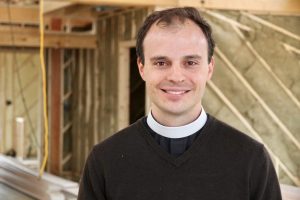
Blake Johnson
Blake Johnson is the Rector of Church of the Holy Cross in Crozet, VA.
Credo Magazine

Advertisment
