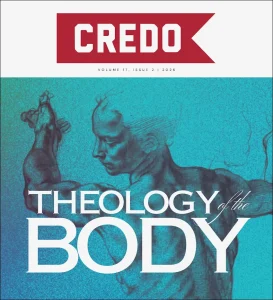
When Pope John Paul II delivered his lectures on the Theology of the Body, he marked a defining moment in the Christian response to the modern cultural milieu of materialistic secularism, especially to those questions concerning embodiment, such as marriage, sexuality, and the relationship between the body, human identity, and personal dignity. Thus, the de facto representative of Western Christianity established the framework for an important conversation that has continued to this day. No Christian tradition can any longer ignore the rising issues of our times concerning the body or the Pope’s response to these controversies. In his short book, Theology of the Body, Jean-Claude Larchet enters this conversation, articulating a distinctly Eastern Orthodox view of the subject.
The greatest contribution the book offers is to help us realize that no complete theology of the body can be formed without the voice of the ancient Fathers of the Church as central in its formulation. Larchet finds that the primary problem a complete theology of the body will explain is the ambiguity of the relationship between the body and soul. Larchet argues that a complete theology of the body can already be found in the ancient Fathers of the East, as opposed to the tradition of the West, which “bears a heavy responsibility for the deprecation…of the body that our culture has known” and the resulting pendulum swing toward the “glorification of the body as an instrument of pleasure” that is plainly visible in our modern moment. As a Western Christian, I find that Larchet drops other dismissive remarks about Western views without any real arguments. These are often skin-deep and detract from an otherwise wonderful book.
The image of God was created not in either body or soul alone, but in the unified composite of both. Share on XLarchet begins his study at creation by considering the human in his original state. He argues quite effectively from a broad range of Eastern Fathers, including Gregory of Nyssa, Athanasius, and Irenaeus, for that age-old Christian formula that man is not merely a soul with a body but at the same time both soul and body, in opposition to the ancient heresies of Gnosticism on the one hand and materialism on the other. Larchet argues that the Fathers protect a harmonious balance of these two substances, which form the human composite. This balance is important because the image of God was created not in either body or soul alone, but in the unified composite of both. In God’s good wisdom and eternal foreknowledge, he created humanity to reflect the incarnate Word, which was yet to take on flesh. Thus, the body, properly united to the soul, is an essential aspect of the image of God. Therefore, it is the duty of man to seek virtue not only in the soul but also in the body. “A life lived virtuously involves both soul and body.”
When Adam sinned, it was not merely a soulish sin. Due to the balance of those two substances, soul and body, and the way God created his image bearers, the first man’s sin involved his entire person, and therefore the effects of sin would likewise touch both soul and body. And if man becomes god by grace yet remains fully human, as the doctrine of theosis holds, then the body is also destined to be divinized along with the soul and requires a similar effort toward its deification.
Perhaps Larchet’s strongest argument is found in chapter three, which shows how Christ’s incarnation elevates the body to a supreme value and how the centrality of this doctrine in Christianity uniquely exalts the view of the body above that of other religions. While this is obviously true of the bodily suffering Christ faced in the passion, it is not limited to that event. Larchet makes a compelling case, particularly in his discussion of Maximus the Confessor’s interpretation of Christ’s temptation, that the tradition teaches that Christ accomplished his work of salvation through the suffering of his body throughout his life.
God's plan of salvation is thoroughly incarnational. At every stage, Christ redeems us by means of his human body. Share on XThrough his incarnation, Christ accomplishes our salvation. Through his victory over temptation, he opens for us a way of escape from our fleshly desires. Through his transfiguration, God reveals the immense worth he places on the body. Through the Eucharist, Christ invites us into communion with the divine by means suited to our bodily nature. Through his death, he bears our sins in his own body. Through his resurrection, he liberates the body from death and bestows eternal life, not only on the soul but also on the body. Through his ascension, he opens the way for our bodily participation in the divine nature. His plan of salvation is thoroughly incarnational. At every stage, Christ redeems us by means of his human body.
Following his ascension, it is still by means of his body, the Church, that new Christians are brought into union with him. The Church initiates them into Christ’s body through the sacraments. These are material or bodily signs that unite us ontologically to Christ himself by the power of the Holy Spirit. In baptism, the old man of sin dies, and the new man’s body is washed with holy water.
In the Eucharist, Christ provides his body and blood as sustenance, so that through his flesh we partake not only of the Son, but also of the Father and Spirit, “since the divine nature is one, and common to the three divine persons.” Through the ingestion of Christ, who is a true bearer of our flesh, the communicant becomes a true “Christ-bearer.” Christ in the Christian, the Christian in Christ!
It is through this bodily communion with Christ that Christians are now prepared to fight sin in soul and body and seek virtue, with participation in the divine life as their highest aim. Seeking virtue and overcoming sin still require effort, hard work, and discipline (or ascesis). By means of temperance and asceticism, not necessarily the severe kind our modern minds conjure, we can “weaken the power of the passions and of evil thoughts.”It is through this bodily communion with Christ that Christians are now prepared to fight sin in soul and body and seek virtue, with participation in the divine life as their highest aim. Share on X
Larchet devotes the largest section of the book to the control of sexual behavior, with only brief discussion of dietary discipline. Sex is one of the clearest examples where ascesis is needed to grow in virtue. To Larchet, while one of the principal purposes of sex is procreation, the most important is not procreation, but love.
In a phrase that could be lifted from Gaudium et spes, Larchet defines love as “an opening up to another person, and a free gift of self.” He continues, “Each of the two people united by love gives his or her self to the other and receives the other in return.” Therefore, any sexual activity that does not meet this standard of reciprocal love, regardless of how pleasurable it may be, is immoral in some sense. Like many who came before him, Larchet disregards bodily pleasure as a legitimate end of the sexual union, even if it is a natural byproduct.
From Gregory of Nyssa and Maximus the Confessor, Larchet presents the prominent view in Eastern theology that sexual intercourse is a result of sin. He is careful to note that the Fathers still honor sex and uphold it as something truly beautiful, but only providentially necessary in a fallen world. I disagree. The clear Scriptural mandate to be fruitful and multiply and the natural orientation of the male and female bodies toward union seem to me to present sex as an intentional feature of creation.
While admittedly Larchet’s is the primary Eastern view, it also differs from the views of other Church Fathers, even some Eastern ones. For example, in Stromata 3.17.102, Clement of Alexandria explicitly rejects the view that the serpent introduced sexual intercourse to Adam and Eve, arguing instead that sexual union belonged to them by nature and that to deny this is to disparage God’s creation.
Larchet is strongest when he draws together and clarifies the vast body of Eastern material on anthropology. His extensive footnotes provide a valuable guide for the studious researcher. The book falters when it becomes polemical, offering vague criticisms of Western anthropology without explaining or engaging specific opposing positions. Even so, Larchet’s Theology of the Body remains a helpful primer on Eastern Christian anthropology and a valuable reference for further study.
Photo Credit: Oosman Exptal. B&W

Joshua Rodriguez
Joshua Rodriguez is Assistant to Dr. Matthew Barrett. He has his MDiv from Mid-America Baptist Theological Seminary and is an Anglican layman, patristic enthusiast, and writer at Saints and Society. He lives in Albany, NY with his wife, Kayla, and their six children.
Credo Magazine
Advertisment