What is “worldview” and why are Christians so obsessed with it?
The term “worldview” is thrown around without clarity as to what it means, and even worse, without any way of applying or regulating it. In his new book Against Worldview: Reimaging Christian Formation as Growth In Wisdom, Simon Kennedy says, “The problem is that the concept of worldview is vague. Certain ideas feel important, look neat lined up together, and subsequently get rolled out as if they are definitive for a given person’s worldview.” (12)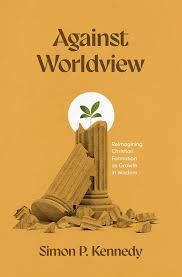
Don’t approach this book thinking that Kennedy is critiquing the concept of worldviews as a wholesale idea, and then offering a better way to describe how Christians should describe their “social lenses.” Instead, what Kennedy proposes is that worldview building should not be the central tenet of education, but that “growth in wisdom ought to be a centerpiece of the Christian understanding of education.” (23) Don’t teach the children what to think, but instead teach them how to think, or as Kennedy offers, provide an inductive education rather than a deductive education.
Kennedy has many helpful insights in this short book, but one in particular stuck out to me. On page 9 he says, “The idea of a Christian worldview feels intuitively plausible, but when it comes to implementing the idea in the practical context of the classroom or lecture hall, the scope seems extremely limited.” For Kennedy, Christian education has to be more than incorporating Bible reading and Scripture memory into classes. After all, should a class on the Industrial Revolution have required Bible reading? Should graphic design courses have theological lessons incorporated? There is a place for those things to be involved in, let’s say, an Introduction to the Arts course, but not a class that should be teaching students the proper methods of utilizing graphic design software.

This brings us back to my point earlier: Christian education should not exclusively be about teaching children what to think, but should be about how to think. Education should be more than intellect and fact knowing; it should be formative in the utmost sense. It should be a process that teaches students how to actively work through problems, how to find the most rational answer, how to… Share on X Education should be more than intellect and fact knowing; it should be formative in the utmost sense. It should be a process that teaches students how to actively work through problems, how to find the most rational answer, how to dialogue, and grow. This is the proposal that Kennedy brings forth, primarily through his illustration of the mosaic. Everyone in education has a small part to play in piecing together the Christian worldview, even if they do not know this worldview exhaustively.
What does this require of the educator? First, the educator must recognize the nuance of what a “Christian worldview” is. Kennedy spends a chapter detailing the complicated background of what worldview can mean. With various definitions, each with its own nuance, it grows increasingly difficult to land on what worldview properly is. Not only must the struggle of nuanced definitions be recognized, but also the standard of what an explicitly Christian worldview can be. What makes a worldview “Christian”? Obviously, it would have to adhere to the orthodox understanding of primary doctrines: the trinity, Christology, soteriology, hamartiology, etc. But what happens when various theological nuances are introduced, particularly those in the “2nd tier” of theological triage? The lack of clarity around the firm and clear factors of a “Christian worldview” is what makes it inadequate to be the basis for an education system.
This is why the inductive system, per Kennedy, is more helpful. Education needs to be about rational observation and building assumptions from what is observable. Kennedy is right to start with this desire, but even still, one faces a struggle: one must hold to a presupposed metaphysic in order to even do Christian inductive learning. The inductive approach is fruitful, but it still requires a starting point of commonality between the educator and the students. Kennedy is aware of this, but for some, reading it may be a hang-up. In order to build a proper inductive education system that informs a Christian worldview, one must start with a Christian worldview. In my estimation, this is where the helpful language of metaphysics comes in. Worldview is far more inclusive, involving dialogue and discussion around all sorts of ideas, including concepts like culture and arts. Metaphysics gets down into the very fabric of reality and nature. One’s held metaphysic does have consequences on their perception and reception of art, but it is not primarily concerned with it. Instead, it has to do with their understanding of reality and the universe. If the student and teacher both start from a Christian metaphysic, then they can proceed into an inductive Christian educational system. Share on X
If the student and teacher both start from a Christian metaphysic, then they can proceed into an inductive Christian educational system. Kennedy moves from this idea into what is, in my opinion, the better half of the book. He clarifies that Christian education is more than “spiritualizing” your subject. On page 98 he says, “Rather than forcing Christianity into the content, educators ought to ask how their teaching will help students think and act wisely in God’s world.” (98) As such, Kennedy may push some strict Protestant readers into an uncomfortable corner: there are more places for wisdom than just the Bible. Kennedy affirms that the Christian tradition and the world both can provide wisdom to the educator in their work. However, he does not place these realms of wisdom on an even playing field with Scripture. He is clear that the Bible is the truest and clearest revelation of wisdom, but it is not the only source of wisdom. Educators need to pull from all of these arenas to instruct their students to be wise.If salvation is about the whole man in the whole world, then why can’t our education system be about the whole student in the whole world? Share on X
Growing in wisdom is the undercurrent of the entire project. Education should be the formation of the whole student, not just the brain. It should train students in memorization, testing, emotions, problem-solving, and more. We should train students to use their senses and rationality to gauge the world around them, evaluate everything accordingly, and make wise decisions that impact the world and the career they end up in. Kennedy does a great job at pushing the reader to get to this edge. But now, looking out, the reader sees a chasm and asks, “What are the practical steps for doing this?”
The solution is not provided in this book; in fact, it leaves you wanting more. Against Worldview gets you to recognize the need for a change, but does not give you the solution. The educator must, with wisdom and reason, work to create a better system. Each system is built according to the institution and course to which it is being applied. However, if I may recommend a tentative solution, one could look to the classical education model. With a focus on the liberal arts and quadrivium, the classical education system promotes wisdom and the formation of the whole student (though I have not read it, I imagine that Passing the Torch: An Apology for Classical Christian Education by Louis Markos is one place to start). If salvation is about the whole man in the whole world, then why can’t our education system be about the whole student in the whole world?

Joel Whitson
Joel Whitson is a ministry associate at King’s Cross Church in Nashville, TN. He is also a Systematic Theology PhD Student at Midwestern Baptist Theological Seminary, where he focuses his studies on participation, joy, asceticism, and the Eastern Orthodox tradition.
Credo Magazine
Advertisment