
It was one no less than C.S. Lewis who directed Christians to the cleansing, antiseptic qualities of reading old books alongside new ones. His direction is now famous:
It’s a good rule after reading a new book never to allow yourself another new one till you have read an old one in between. If that is too much for you, you should at least read one old one to three new ones. … Every age has its own outlook. It is especially good at seeing certain truths and especially liable to make certain mistakes. We all therefore need the books that will correct the characteristic mistakes of our own period. … None of us can fully escape this blindness, but we shall certainly increase it, and weaken our guard against it, if we read only modern books. … The only palliative is to keep the clean sea breeze of the centuries blowing through our minds and this can only be done by reading old books.[1]
Anselm of Canterbury’s brief work On the Virgin Conception and Original Sin is a prime example of the strength of Lewis’s rule for the Christian. This lesser-known work of Anselm’s uses the familiar back-and-forth dialogical style with his inquisitive monk, Boso. Following on the heels of Why God Became Man and composed toward the end of his life, the main thrust of On the Virgin Conception is to give a robust answer to the question of how Christ could be conceived without sin from a woman who is herself a descendent of Adam. And, Anselm doubts that a better argument can be found:
I do not deny that there may be a deeper reasoning to show how God assumed sinless humanity from the sinful mass, as if something unleavened were taken from leaven, beyond that which I have presented here as well as the one I gave elsewhere [in Cur Deus Homo]. If someone can show me such an argument, I will accept it freely and I will not cling to my own reasonings if they can be shown to be contrary to the truth – although I doubt that they can.[2]
Although relatively short, Anselm’s thought here can be dense and his vocabulary somewhat foreign to modern readers. But, this is all the more reason why reading Anselm is rewarding. Called “the most luminous and penetrating intellect between St. Augustine and St. Thomas Aquinas,” here he lives up to his fame.[3]
Below, I’ve listed five reasons you should give your time and attention to Anselm’s brilliant little work.
1. Anselm’s Definition of Sin
Anselm’s definition of sin is simple, penetrating, and practically helpful. Before he arrives at his main topic, he’s already giving out presents. Near the beginning of the work, Anselm dishes out a definition of sin that is worth paying attention to. Anselm says that sin, or, as he would put it, “injustice,” is “nothing.” He is not here undervaluing sin as such, but rather what he is saying is that sin is not an ontological reality, but the deprivation of something good made by God. Listen to his teaching here:
Injustice [sin] itself, however, does not exist, any more than blindness exists. For blindness is nothing but the absence of where vision should be. It is not something present in the eye where sight should be, any more than it would be present in a piece of wood where sight should not be. … [E]vil is nothing but the absence of the good that ought to be there.[4]
Good and evil are not forever locked in an eternal dual because they are emphatically not equals. Never mind equals – evil isn’t even a thing in and of itself. Share on XThis is a powerful (and biblically accurate) affirmation. We are reminded here that Christians are not dualists. We’re not, say, playing with a Star Wars-esque theology. Good and evil are not forever locked in an eternal dual because they are emphatically not equals. Never mind equals – evil isn’t even a thing in and of itself. It is the original good made by God that is strong and solid. Evil is, in that sense, like a cavity in a tooth – a space of nothingness. Though he has become like Swiss cheese, we are reminded here that not even the Devil himself is ontologically evil in that sense. He too was once a good creation of God.
Although Anselm would later be criticized by the Magisterial Reformers for his reliance on reason (summarized in the dictum fides quaerens intellectum – faith seeking understanding) and for not going far enough in terms of sin’s relation to the corruption of the human will, what he does affirm provides a robust and faithful definition of sin. For that, we should be thankful.
2. Mary’s Part & Her Purification
Compared with later Catholic developments, Anselm’s language around Mary’s role in the Incarnation is both properly exalted and yet still restrained. The key passage here states that:
[I]t was fitting that [the] Virgin should shine with a purity which was only exceeded by God’s own, because it was to her that God the Father disposed to give his only Son, whom he loved in his heart as equal to himself. … Of how the Virgin was cleansed by faith before this conception I have spoken in the course of another treatise on this subject.[5]
Although Anselm does not assert or claim an Immaculate Conception for Mary (and, I would point out that he is not affirming this at the end of the 11th century – a very late date indeed!), he does have a deep reverence for her, found in his belief that she was properly purified and kept as the new Ark for the Son in a unique way – something that Protestants most assuredly affirm.
3. Natural Sin, Personal Sin & The Conception of the Son
So, whence comes Christ? Not from the will of Adam. And, for Anselm, that is point. Every other child ever conceived shares in Adam’s “natural” sin even if they do not share in Adam’s “personal” sin. But not Christ. Share on XTo come to the crux of the work, however, the question still remains: how exactly did God take to himself a virgin from sinful human and remain pure from the taint of sin? Anselm’s conception of sin centers heavily on its tie to the will of man. Without that sinful will in play, says Anselm, no sin can be passed down and human nature, which remains good in so far as that it was created by God (see my point #1), can be redeemed. This is exactly what he sees happening in the Incarnation.
Adam was created with what Anselm would call “justice” – a righteous integrity of body and soul. Through sin, not only was that justice lost, but passed down to all his descendants. Anselm here makes a careful distinction between what he would call “personal” sin and “natural” sin (this is synonymous with original sin):
As I have said, there is the sin committed by the nature, and there is sin committed by the person. Therefore what is committed by the person can be called “personal,” while what comes from nature is called “natural” sin.”[6]
So, whence comes Christ? Not from the will of Adam. And, for Anselm, that is point. Every other child ever conceived shares in Adam’s “natural” sin even if they do not share in Adam’s “personal” sin. But not Christ:
Down through the line of our ancestors, as far as the Virgin his Mother, the will sowed the seed and nature brought it to life, so that the Virgin herself … took her being from Adam, like all others: but in her neither the will of a creature sowed her offspring, nor did nature nurture it, but the Holy Spirit and Power of the Highest effected the miraculous propagation of a man from a virgin woman. … [O]nly God made the Son of the Virgin, in a sense from Adam, although not through Adam but through his own power, as it were from [God] himself.[7]
This sheds an interesting light on John the Apostle’s affirmation that “to all who did receive him, who believed in his name, he gave the right to become children of God, who were born, not of blood nor of the will of the flesh nor of the will of man, but of God” (John 1:12-13). This is, of course, from John’s Prologue, which is all about the Incarnation of the Word himself, who was emphatically not born “of the will of the flesh nor of the will of man.” Without a doubt, Anselm is echoing the teaching of the Apostle John.
4. The Son’s Justice & Justness
Since Jesus has this “original justice” it is he alone who is capable of giving to the Father the active obedience and purity owed to God in place of the first Adam. Share on XThe outcome of this is that the Virgin’s Son had “original justice” instead of original sin, another great little phrase used by Anselm in this work. In Jesus, a just Son comes forth in the human race, something not seen since Adam knew God in garden. Chapter 20 explicates it this way:
Therefore because according to his divine nature he was born of a just father, and a just mother according to his human nature, he was born just from his very origin, as we might say: it would not be out of place to say that he had original justice instead of the original sin which all Adam’s sons have from their origin.[8]
Since Jesus has this “original justice” it is he alone who is capable of giving to the Father the active obedience and purity owed to God in place of the first Adam.
5. Satisfaction & Salvation through Christ Alone
Lastly, as in Cur Deus Homo, Anselm champions clarity on the Gospel, something for which Protestants can remain thankful. For instance, when writing on the magnitude of original sin, Anselm makes a wonderfully clear statement about Christ:
[H]ow does a just God demand from them satisfaction for a sin of which they are not guilty? I would say that God does not demand more from a sinner than he owes, but since no one can repay as much as he owes, only Christ renders on behalf of all who are saved more than they owe, as I have explained in my well-quoted little work [Cur Deus Homo].[9]
In other words, his mercy is more! Where sin increased, grace abounded all the more (Romans 5:20).
In Anselm, we have worthy Teacher of the Faith and an ongoing conversation partner. This little work, which can be read in a sitting or two, will deepen your understanding of both the depth and meaning of original sin, the miracle of the Virgin Birth, and solid-gold purity of the life and person of our Lord Jesus Christ. Take up and read – the early Christmas presents are stacked under the tree and waiting to be opened.
Notes:
[1] C.S. Lewis, introduction to Athanasius: The Incarnation of the Word of God, trans. by A Religious of C.S.M.V. (Macmillian, 1946), 7.
[2] Brian Davies and G.R. Evans, eds., Anselm of Canterbury: The Major Works (Oxford University Press, 2008), 378.
[3] Frank Leslie Cross; Elizabeth A. Livingstone, eds. “St Anselm”, The Oxford Dictionary of the Christian Church (3rd ed.), (Oxford University Press, 2005), 73–75.
[4] Brian Davies and G.R. Evans, eds., Anselm of Canterbury: The Major Works, 364 and 365.
[5] Davies and Evans, Anselm of Canterbury: The Major Works, 376.
[6] Davies and Evans, Anselm of Canterbury: The Major Works, 382.
[7] Davies and Evans, Anselm of Canterbury: The Major Works, 380-1.
[8] Davies and Evans, Anselm of Canterbury: The Major Works, 377.
[9] Davies and Evans, Anselm of Canterbury: The Major Works, 379, emphasis mine.
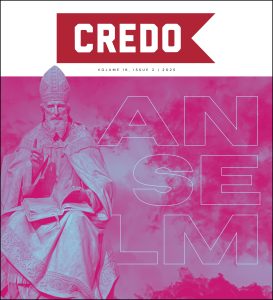
Image Credit: Tony Hisgett | Flickr

Justin Clemente
Justin Clemente serves as the Associate Pastor for Holy Cross Cathedral, the cathedral church of the Anglican Diocese of the South (ADOTS) in the Anglican Church in North America. He’s also a core writer over at Anglican Compass and author of At the Cross: Reflections on the Stations of the Cross, recently published by the same. He has a supportive and strong homemaking wife of twenty-one years and six beautiful children. They’re the best thing he’s ever done.
Credo Magazine
Advertisment
