For this issue of Credo, we sat down with Dr. Matthew Minerd to discuss his life and work as a dedicated Thomist. Dr. Minerd is the author of many books, including the translation of many Thomistic works such as The Thomistic Response to the Nouvelle Théologie. In this interview with executive editor Connor Shackelford, Dr. Minerd answers questions about his life’s work, ranging from his favorite translated works to his ongoing projects. Most importantly, he points our readers to the continued importance of the Thomistic tradition in the life of the church today.
What inspired you to devote so much of your professional work to translating Thomistic texts?
 A great deal of the work I’ve done has been inspired by my own desire to learn. Most of the texts I’ve translated are ones I selected myself—works that I believed were worth learning from and then presenting to the reading public. One really digests an author by translating, and so I’ve tried to make ninety percent or more of my translation workload consist of texts that genuinely interest me. You’ll notice the close connection between my own academic writing and the works I have translated; that overlap says a great deal about my intellectual bent.
I would be lying, however, if I didn’t also mention that I believe our era could stand to learn far more from the great masters of the past. There has been a pervasive forgetfulness in our culture for many decades. True docility is needed now more than ever, and that conviction has also motivated my translation work.
Finally—and to be completely truthful—there was, at least at the beginning, a bit of a “red-pilled” impulse. I started translating partly out of frustration that certain scholastic works had been misrepresented to me and to others. I wanted to do justice to Garrigou-Lagrange, who has been—and still is—both maligned and weaponized.
Do you have a favorite text you’ve translated, and why?
By far, Ambroise Gardeil’s The True Christian Life stands at the top. The work is a profound piece of moral theology, pound-for-pound packed with insight. It contains the best thirty-page description of divinization—and of some of its counterfeits—that I know of. The section on prudence illuminates the entire process of Christian moral discernment, showing that Thomism is as supple about moral contingency as it is solid concerning moral absolutes. His treatment of religion, devotion, and prayer is theologically sober yet rhetorically charged, and it leaves the reader genuinely transformed. Add to this the introduction compiled by his nephew, which offers a remarkably clear framework for a complete moral theology, and the book becomes even more impressive.
Although I have changed as a Byzantine Catholic, I still find myself drawing from this well often. Fundamental moral theology remains my favorite course to teach, and if I could, I would teach this text. It’s not entirely appropriate for use at the Byzantine seminary—though I do use the chapter on divinization. However, I have, in fact, used it at another institution, and the students benefited tremendously. You can see its fingerprints all over my own Made by God, Made for God; the endnotes bear witness to this.
A close second is Volume II of Journet’s The Church of the Word Incarnate. I believe he was a true saint, and this volume, in particular, is speculatively powerful in its treatment of the nature of the Church. The chapter on Christ’s headship over the Church—a roughly three-hundred-page tour de force—is worth the price of admission by itself. But the entire work is stupendous: solid intellectual work continually interwoven with the loving spirit of a holy theologian.
What would the church lose by ignoring or downplaying the Thomistic tradition on metaphysics?
I must admit openly that there is a kind of ambiguity in the expression “the church” here. As a Catholic, I am wedded to a particular ecclesiology that may differ from what the question presumes. (For how I would doctrinally and dogmatically articulate “the Church,” I would recommend texts from Vatican II—especially Lumen Gentium, Christus Dominus, Orientalium Ecclesiarum, and Unitatis redintegratio. Theologically, one should see the works of Charles Journet, Jean-Hervé Nicolas, Benoît-Dominique de La Soujeole, and—especially for points related to the Christian East—Yves Congar, Jean Daniélou, and aspects of Joseph Ratzinger.) For the sake of the following questions, then, I will interpret “the church” as referring to Christian believers committed to the great creedal truths of the faith and to a broadly sacramental-liturgical outlook—and also to readers at least sympathetic to such a Christianity. Obviously, I have a profound respect for the readers of your website who might not be Catholic. Yet, I also feel it necessary to avoid equivocation, for the sake of honesty on my part.
Turning to the question itself…
On the one hand, there is a real risk of losing the sober understanding that metaphysics is a kind of terminal achievement of human reason among the natural philosophical disciplines. Metaphysics is not something we simply jump into as though it were the shallow end of the intellectual pool. It is only through long and laborious philosophical reflection that we gain a disciplined appreciation of the principles, effects, and properties that attend upon being in its full breadth: from created being, through the unique domains of embodied-spiritual being in human art, craft, and morality, to the uncreated being of God—which, philosophically, can only be “glanced” at from afar, shrouded in mystery, through the mirror of created realities. This methodological sobriety is, I think, one of the more important aspects of Thomism that is often underappreciated.
It is only through long and laborious philosophical reflection that we gain a disciplined appreciation of the principles, effects, and properties that attend upon being in its full breadth. Share on XOf course, one could choose many particular topics. First among them would be the real distinction between act and potency in all finite beings, with all of its implications. I do not like speaking of “realism” vs. “idealism,” as I think that framing mislocates the issues. But to put the matter differently, another example deeply important to my own thought is the relationship between noetics and metaphysics. Much of modern epistemology has ended in useless dead ends precisely because it has not grounded itself in the primordial fact that knowledge and love are ways of being. A sound metaphysics articulates the permeable reality of being and knowing that surrounds us. Thomism has immensely rich resources for this, and I think these resources benefit our understanding of doctrine, the stability and historicity of human knowing, the relationship between nature and culture, nature and the supernatural, the world and the Church, and so on.
You have translated much of Reginald Garrigou-Lagrange’s work. What does he offer the church today that we are missing?
He is a voice from within a tradition of Thomism engaged in a living, ongoing dialogue with the questions of philosophy and theology. In a certain sense, he models for us what it means to be a thinker within this tradition. He was no mere repeater of the past; rather, he shows the fecundity that comes from being deeply rooted in a tradition. Great human achievements arise only through the labor of many generations, yet we moderns often try to build our castles without foundations, anew in every age. A charitable reading of his works reveals, however, that his mind was always “on the move.” This has been my constant experience each time I revisit his writings.
Great human achievements arise only through the labor of many generations, yet we moderns often try to build our castles without foundations, anew in every age. Share on XMoreover—and this may surprise some readers—I attribute the fecundity of someone like Jacques Maritain precisely to the fact that he drew from this same deep tradition, often in direct dependence on Garrigou-Lagrange himself, or, when not directly, through the very same sources in the Thomistic lineage that nourished the Dominican theologian. (It might also interest you that I am a huge fan of John Deely, whose semiotic Thomism is infinitely more so in this line of Thomism than it is in the line of much contemporary academic Thomism.)
Of course, to speak more concretely, I would especially highlight his works in moral and spiritual theology. They contain a wealth of resources for fostering a deeper appreciation of divinization as central to sound moral theology. In the West, this appreciation is still becoming institutionalized, and Garrigou-Lagrange stands at the center of the best discussions of the last century.
How should the church today implement the kind of Thomistic common sense for which Reginald Garrigou-Lagrange was advocating?
Well, this is amusing. I actually am opposed to the title of the book Thomistic Common Sense. I used to blame the publisher, thinking they had chosen it simply to sell books. But recently someone dug through old emails and discovered that I had suggested the title while trying to help the marketing team come up with something that would “hit the target.” It’s still not an ideal title, but I’m always a little oversensitive about letting marketers do whatever they need to do to make a book seem interesting.
But in fact, the book really is about pre-philosophical knowledge as a kind of common sense. Garrigou-Lagrange argues that the Aristotelian and Scholastic tradition—and I would add that this applies as well to Platonism and Stoicism—grows out of a reflection on the basic data of common sense: truths grasped pre-philosophically and then given principial structure in light of the first principles of the realities under consideration. In that book, he is trying to show how dogma presupposes this sort of common-sense “realism”— remember, however, I dislike the term “realism”—and how this relates to the faulty epistemological claims of certain Catholic “modernists” (especially George Tyrrell, though Édouard Le Roy is also clearly in view, as well as the non-Catholic philosopher Henri Bergson). He wants to show that the intellect, even before the construction of a philosophical scaffolding, is made to articulate the being of things, not merely to create symbolic patterns meant to stabilize an ultimately ineffable experience of the world.
I don’t think there is any kind of simple “implementation” that can be deployed in a practical fashion. This is, in many ways, a question of culture, which confronts us today with enormous clarity. It’s not merely a matter of locating the right propositions for everyone to believe, armed with a set of “common sense realist” tools. Obviously, I am committed to the great objective, articulated truths of Thomism, and I think they matter. But they must live within a culture that forms us to be agents wedded to being—or, as my teacher Msgr. Robert Sokolowski would say, agents of truth. I don’t have ready-made answers for how to accomplish that.
You know… there is a great deal of truth in the cultural project of someone like John Senior here in the United States. I have important differences with Senior himself and with some of his inheritors. I think a certain parochial—or “learnedly parochial”—reactionary conservatism often grows out of that soil, and it can lend itself to a kind of strange hybrid of triumphalist and bunker mentality. I have always been uncomfortable with the sense of ideologization in the place of well-integrated authenticity. I think that certain strands of reactionary Catholicism today are particularly susceptible to this. Yet, if I risk leading with my chin, I nonetheless believe that the broader project of cultivating wonder, imagination, and real culture—a project dear to Senior and his successors—is not unimportant. Why? Because common sense thrives only within a common culture, one that lives from the conviction that man is a being made for being—naturally and supernaturally. But this does not mean I am proposing any one model. That feels far too artificial.
What is the nouvelle théologie movement, and how did the Thomistic tradition respond to it?
I sometimes feel that every answer to these kinds of questions begins with a tale that sounds like this: well… in order to answer that, we really need to go back five centuries, or seven centuries, or more than a millennium!
However, let’s be more proximate. The phrase “nouvelle théologie” refers to a controversy that arose in the 1940s between Jesuits associated with Fourvière (Henri de Lubac, Jean Daniélou, Henri Bouillard, Hans Urs von Balthasar, et al.) and Dominicans in Rome (Reginald Garrigou-Lagrange) and Toulouse (Marie-Michel Labourdette, Marie-Joseph Nicolas, and Raymond-Léopold Bruckberger). At its heart, the debate concerned the nature of truth—particularly whether the mind can settle itself in conceptually absolute, trans-temporal claims, especially in matters of dogma—and the relationship between scholastic theology (in its discursive-scientific mode) and the sources of theology (Scripture, the Fathers, and the liturgy).
The controversy is quite complex, and it touches on issues that had been developing throughout modern theology, especially since the mid-19th century with the tremendous growth of historical studies across the humanities and within the Church herself. (One may simply think of the immense labor of Jacques Migne and his dual Patrologia series.) For those who want an account that tries to stay close to the actual texts, I recommend the book I co-authored with my friend Dr. Jon Kirwan, The Thomistic Response to the Nouvelle Théologie. For a counterweight, one should also read Jürgen Mettepenningen’s Nouvelle Théologie – New Theology: Inheritor of Modernism, Precursor of Vatican II.
This debate—which burned very brightly for several years and then came to an abrupt halt after the promulgation of Humani generis—continued simmering beneath the surface until the Second Vatican Council. Many of its central questions, especially those concerning theological method and the relationship between theology and its sources, became driving forces behind the major divisions among bishops and periti at the Council. Catholics are still living in the wake of this debate, which arguably has not reached a final resolution.
I dislike sounding as though I am selling my own book, but I genuinely think it is best to turn readers to the primary texts themselves. Otherwise, they will come away with a partial picture, one prone to exaggerations on both sides. In my view, this is one of the most important debates of twentieth-century Catholicism, at least in terms of the breadth of its implications. Even if one is not Catholic, the issues at stake—about the nature of faith, theology, and reason—are deeply relevant. (Indeed, one of the chapters of our book chronicles Protestant responses to the debate, something I found particularly interesting.)
What can we learn from the Thomistic response to the nouvelle théologie movement?
Well, here you force my hand a bit! Above all, the most important aspect of this debate is the continual affirmation that dogma really is, in crucial ways, conceptual. Yes, faith involves a kind of “super-analogy,” because our concepts are stretched in order to express supernatural truth. But the truths of Christian revelation are truths in the strongest sense. They are statements about reality that specify our minds so that we might be drawn into union with the Triune God who saves us in Christ. One cannot repeat this enough: the ladder of dogma can never be kicked out from underneath us. Likewise, dogma is not merely a pragmatic guide for how we should act—it is a disclosure of what reality is.
Obviously, the Church’s understanding of the truths of faith can develop; this is incontrovertible, and none of the Dominicans involved in the controversy ever dreamt of denying it. But dogma nonetheless opens the soul onto the very Uncreated Reality of the Triune God, the One who saves us in Christ, the firstborn of all creation, whose full created radiance will be the glory of the resurrected blessed.
This debate also directs us toward another important question facing theology (and, at times, philosophy among Christians): is theology primarily the study of theologians, or is it the study of God? It should be obvious that it is first and foremost the latter; this is its deepest formality. And yet, much of academic theological culture now functions in the mode of what my friend Fr. Cajetan Cuddy calls “theologianology.” We all recognize the phenomenon: people staking out positions based on which authors say what, while shrinking back from making definitive statements about reality itself. There is often a fear of the Absolute. And yet the Fathers committed themselves to absolute claims about who Christ is and who the Trinity is. Some may find this pugilistic, but I am convinced that an overemphasis on sources and textual dialectic has reduced theology (and even philosophy, especially in its scholastic modes) to a conversation among authorities, rather than an articulation of reality itself—above all the Uncreated Reality revealed in Christ.
Finally, there is an important background element in the whole debate: the relationship between mysticism and holiness, on the one hand, and discursive theology on the other. This remains a vital question still needing resolution, both within Western Christianity and also in the dialogue between East and West.
How does the Thomistic tradition uniquely position the church to worship the Triune God as we should?
What is often meant by “Thomism” is a particular way of doing discursive theology. It is not the highest form of discourse about God. The highest form of discourse about God is, of course, the mystical life. Yet discursive theology plays a very important role in stabilizing the intelligibility of the mysteries in the mind of the faithful. This “intelligibility of the mysteries”—the particular intellectus fidei proper to discursive theology—is not the whole of Christianity. The transfigured life, lived in Christ as His members, is the real heart of Christianity: true orthodoxy, true doxology, the true “glory” offered by the divinized faithful who make up the mystical Body of the Word Incarnate.
But there is also an “orthodoxy of the discursive, supernaturalized mind,” and I believe this is where Thomism’s particular vocation lies. We do not live compartmentalized lives in which we simply perform liturgy fideistically. We also seek to understand the message handed down to us, and we do so with the feeble but nonetheless real instrument of reason illuminated by faith. Of all the schools of discursive theology, I still feel—after all my years as a Byzantine Catholic—that Thomism uniquely places first things first, second things second, third things third, and so on. It places the Trinity as the keystone, with rigorous and docile honesty, then the Redemptive Incarnation, and in the light of these two credibilia explains all the rest.
Of all the schools of discursive theology, I still feel that Thomism uniquely places first things first, second things second, third things third, and so on. Share on XThomism does this with particular radiance when it is communicated through a long, living tradition of inquiry, united to a prayer life that actually lives the mysteries—for the revealed mysteries are indeed our mysteries, to be lived, but lived as truths that indicate to us reality itself. True discursive theology plays its role—not the only role in the supernatural economy, but a real and indispensable one—by stabilizing and deepening our insight into two central truths: that God is Father, Son, and Holy Spirit; and that Christ, the Incarnate Word, is the firstborn of all creation, whose primacy shapes the whole economy of salvation.
To see these truths—even in this subordinate, secondary, yet utterly essential mode of discourse—cannot fail to straighten the soul. It allows the true doxology, the true orthodoxy, to unite head and heart in the loving praise of God, above all in the Liturgy, where the “whole Christ” gives God back to God in the most profound sense possible. For this is the mystery of our life of grace, the meaning of divinization itself: to receive God from God, and to give Him back to Him. Thomistic theology is a very capable instrument for ensuring the vigor of this living Trinitarian-Economic-Trinitarian cycle.
Besides your work as an author, where else can our readers interact with your work?
I try to keep my professional website up-to-date, as much as one can amid various labors: https://www.matthewminerd.com. I also run a website with my friend Fr. Cajetan Cuddy, O.P., where we post work that is still “in progress.” For my part, I often describe it as the place where I put the brownies and cookies I’ve baked about 75 or 80 percent of the way. They’re unfinished pieces, but still things I won’t publish elsewhere in their posted form. They are, however, clean enough to read, and so we make them available to anyone who is interested. We call the site To Be a Thomist. Its purpose is simply to make public some of the ways we function as contemporary Thomists—doing Thomism in public. My posts there are a mixture of personal work and translation, because that is my own particular way of being a Thomist. The site can be found at: https://www.athomist.com.
Image Credit: public domain
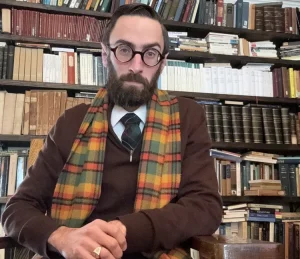
Matthew Minerd
A Ruthenian Catholic, husband, and father, Matthew Minerd is a professor of philosophy and moral theology at Ss. Cyril and Methodius Byzantine Catholic Seminary in Pittsburgh, PA. My academic work has appeared in the journals Nova et Vetera, The American Catholic Philosophical Quarterly, National Catholic Bioethics Quarterly, Saint Anselm Journal, Lex Naturalis, Downside Review, The Review of Metaphysics, and Maritain Studies, as well in volumes published by the American Maritain Association through the Catholic University of America Press. I have served as author, translator, and/or editor for volumes published by The Catholic University of America Press, Emmaus Academic, Cluny Media, and Ascension Press.
Credo Magazine

Advertisment