Register for Aquinas KC
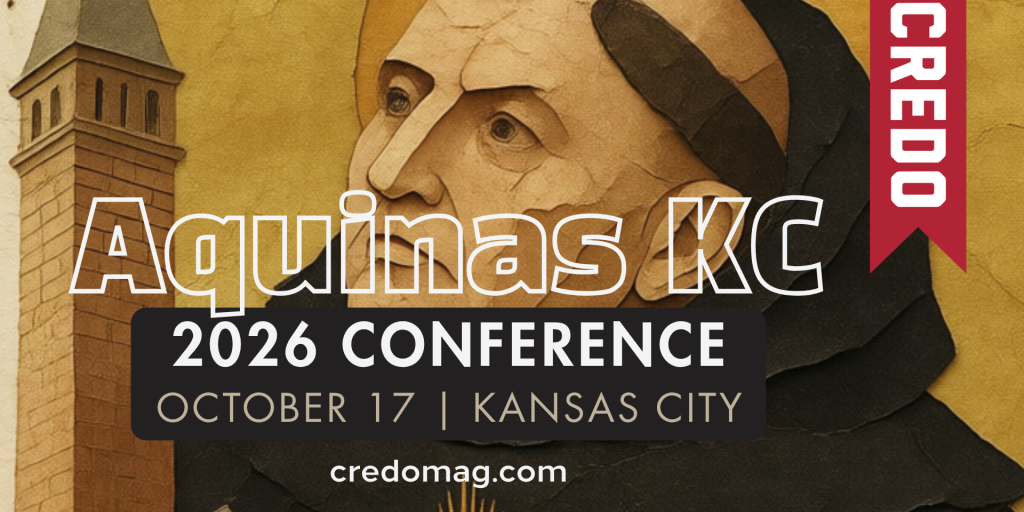
Did you know we are launching a brand new conference in Kansas City! It’s one of a kind. Over the centuries Thomas Aquinas has been called a common doctor due in part to the profundity of his writings across many disciplines. Catholics are not alone in this assessment, as Protestants today are recognizing that Aquinas is a reservoir of wisdom. It is time for a fresh ecumenism, one in which we gather around Aquinas and together face outward, equipped by our common doctor to answer the challenges of our day. We believe that Aquinas’ theological approach to philosophy and theology merits retrieval during times of severe societal division leading to cultural anomie. It is time we rally around Aquinas’s First Principles to respond to a culture suspicious of God and the goodness of his creation.
Aquinas KC deploys this Thomistic style and strategy to unite Protestants and Catholics in a search for common ground for the common good. To that end, Aquinas KC is a school for catechizing one another in the Thomistic way in our secular age.
In the years ahead, Aquinas KC will create several new interventions, including Thomistic Fellowship Circles as well as an annual conference. REGISTER HERE
What will the first conference be about?

The first conference will focus on: The Happy Life—Human Flourishing and the Search for God. The inaugural conference for Aquinas KC will launch October 17th, 2026. Aquinas KC will be hosted by Donnelly College in Kansas City. Seating is limited so register soon! Conference speakers include:
Dominic Legge, O.P., president of the Dominican House of Studies. Previously, he was the director of the Thomistic Institute.
Matthew Barrett, research professor of theology at Trinity Anglican Seminary and previously the McDonald Agape visiting scholar at the Dominican House of Studies and the Thomistic Institute. REGISTER HERE.
Who is recommending Aquinas KC?
“Aquinas is rightly said to provide a common grammar for Christian doctrine in the west. His philosophical and theological reflections allow us to name the central realities of Christian faith, and on a practical and spiritual level, they provide us with ballast in the midst of the storms of life. They teach us to love God and neighbor truly in accord with the life of the Spirit and the virtues. Developing a conversation around the teaching of this common doctor in an ecumenical context today is both visionary and promising.” -Fr. Thomas Joseph White, Rector Magnificus of the Pontifical University of St. Thomas (Angelicum) in Rome
.png?mask=1)
“We shan’t be able to talk adequately about the common good unless we have two things clearly in place — a clear vision of the shared orientation of human existence towards communion with the Trinity and an equally clear vision of how this implies a radical communion with all other human beings. The great architecture of St. Thomas’s thinking
provides abundant resources for exploring and deepening our grasp of these truths. Torn as we are these days between mechanistic pictures of human behaviour on the one hand and rootless voluntarism and individualism on the other, we badly need a philosophy and theology that show us where we are properly at home as human beings – quite simply, as finite, unique, and precious intelligences, invited to find the fulfillment of that intelligence in loving interdependence. St. Thomas, inheritor not only of Augustine but of the Greek Fathers, devotes all his exceptional genius ultimately to the task of laying out the journey to this being at home with God, with God’s world, and with ourselves.” -Rowan Williams, 104th Archbishop of Canterbury
“The Christian church has two thousand years of reflection on what it means to be human, how we live together, where we came from
and who God is. In difficult times, it is of great value to draw on the wisdom of great thinkers from the Christian past to help navigate the complexities of the modern world. This initiative, drawing on the remarkable achievement of Thomas Aquinas, with his grand vision of nature and grace, and how they help us understand our world, will be a gift for all churches as they seek to witness to Christ in our day.” -The Rt Revd Dr Graham Tomlin, Chair, Inter-Anglican Standing Commission on Unity, Faith and Order. Editor-in-Chief, SeenandUnseen.com
“Aquinas’s clear and systematic approach to thinking provides an incredibly helpful framework for working through key questions facing us today. Anyone wanting to think through today’s hard questions will benefit from engaging the clear thinking of Aquinas” -Anna Halpine, Founder, World Youth Alliance
“I welcome this new initiative to encourage a deeper, fuller interest in the work of St. Thomas Aquinas. Thomas is best understood, I believe, as an outstanding luminary within the wider Augustinian tradition. The entire body of Christ will be enriched by careful study of Thomas and his writings, especially his commentaries on Holy Scripture.” -Timothy George, Distinguished Professor of Divinity, Beeson Divinity School
%20(3).png?mask=1)
“Aquinas KC is an amazing initiative about bringing Catholics and Protestants together through the theology of Thomas Aquinas to meet, pray, reflect, and study together the divine mysteries that Aquinas dedicated his life to helping others grasp with increasing insight and greater devotion. ” -Michael Michael Bird, Deputy Principal: Academic Lecturer in Theology, Ridley College
“As the Church is confronted with aggressive secularism and religious totalitarianism, God is drawing orthodox Protestants and Catholics together. One such meeting place is Aquinas KC, an ideal venue for exploring how a theological giant can help the Church understand its deepest roots, both philosophically and biblically.” -Gerald McDermott, Anglican theologian and author of A New History of Redemption: The Work of Jesus the Messiah Through the Millennia
“The significance of Thomas Aquinas’ thought in addressing the contemporary challenges facing our culture—such as education, ecology, and interreligious and intercultural dialogue—is undeniable. His role as a revered teacher and longstanding authority within the Catholic Church extends beyond religious boundaries, as his ideas were not only responsive to the issues of his own time but also continue to inspire us today.” =Sr. Teresa Obolevitch, Professor and Chair of Philosophy of God and Religion at the Pontifical University of John Paul II in Krakow, Poland
“The writings of Thomas Aquinas are a great gift to the Christian church. Overflowing with biblical, philosophical, and moral insight, they provide a way forward for Christians today, as we seek to love God and our neighbour in relation to God. I commend wholeheartedly this initiative, confident that it will be a blessing to the church catholic, and nourishing of faith in and service to our common Lord.” -Christopher Holmes, professor of systematic theology at the University of Otago
%20(2).png?mask=1)
“The genius of Aquinas was that he created a theology in conversation. Grounded in his training as Augustinian Platonist, he engaged with the rediscovery of Aristotelian thought and the best of Islamic and Jewish thinkers to create a response to the challenges of his day. Let us gather around and learn afresh from not simply his insights but his profound, conversational methodology.” -The Very Rev. Ian S. Markham, Ph.D. The Dean and President of Virginia Theological Seminary and the President of The General Theological Seminary and the professor of theology and ethics.
%20(4).png?mask=1)
Credo Editors
This article is brought to you by the Credo Editors
Advertisment